I learned in Nutrition yesterday that the government allows a certain % of foreign bodies in canned or packaged food. My professor is a food scientist and used to work for Campbell's and she said that there were snakes in the tomatoes; people wouldn't pull out the snakes off the assembly line before the tomatoes were to be processed so the snakes would be boiled in with the tomatoes. Also rat hair and feces were found but they let it go because the final product would test less than 5%.
She then tried to make us feel better by saying, "Don't worry, cooked feces won't kill you."
I don't think very many of us were going to rush out and buy canned food after class.
Showing posts with label Food Industry. Show all posts
Showing posts with label Food Industry. Show all posts
Friday, January 29, 2010


Sunday, September 13, 2009
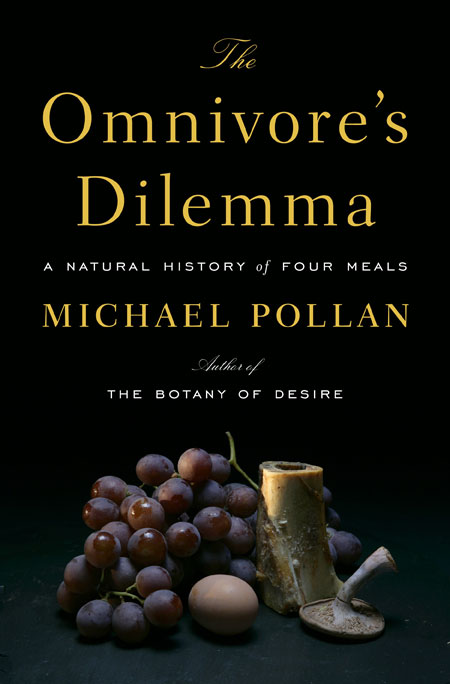
The Book That Ruined My Life!
Monday, September 7, 2009
Fresh
King Corn
Sunday, September 6, 2009
Corn-fed vs. Grass-fed Beef
Farmer's Market Again...

I'm proud of the fact that I haven't stepped inside a large grocery chain like Safeway for a few months now. Most of my produce has come from the Farmer's Market, and a few things from the Asian supermarket. Also, the farmer's market is much more interesting and exciting than the generic supermarket. The supermarket doesn't have live cooking demonstrations using vegetables and fruits that are in season. You get tastings and recipe ideas for free...

In the documentary Food Inc, Michael Pollan says that you're better off buying at the farmer's market these days since you are face to face with the person who is growing your food. At least you're guaranteed that the food you will be eating is real food.
«Other reasons why you should buy local...»
Source: greenrightnow.com
After declining for more than a century, the number of U.S. small farms has increased 20 percent in the past six years. This is in large part a result of the growing demand for locally grown foods, which is slowly but surely shaping the business of food.
Brenton Johnson, an organic farmer and owner of Johnson’s Backyard Garden, came up with this list of top 10 reasons to buy local food, based on his philosophy to live in harmony with the land.
1. Locally grown food tastes better.
Food grown in your own community is usually picked within the past day or two. It’s crisp, sweet, and loaded with flavor. Produce flown or trucked in is much older. Several studies have shown that the average distance food travels from farm to plate is 1,500 miles.
2. Local produce is better for you.
Fresh [supermarket] produce loses nutrients quickly. Locally grown food, purchased soon after harvest, retains its nutrients.
3. Local food preserves genetic diversity.
In the modern industrial agricultural system, varieties are chosen for their ability to ripen simultaneously and withstand harvesting equipment. Only a handful of varieties of fruits and vegetables meet those rigorous demands, so there is little genetic diversity in the plants grown. Local farms, in contrast, grow a huge number of varieties to provide a long season of harvest, an array of eye-catching colors, and the best flavors.
4. Local food is GMO-free.
Although biotechnology companies have been trying to commercialize genetically modified fruits and vegetables, they are currently licensing them only to large factory-style farms. Local farmers don’t have access to genetically modified seed, and most of them wouldn’t use it even if they could.
5. Local food supports local farm families.
With fewer than 1 million Americans now listing farming as their primary occupation, farmers are a vanishing breed. Local farmers who sell direct to consumers cut out the middle man and get full retail price for their crops.
6. Local food builds a stronger community.
When you buy direct from the farmer, you are re-establishing a time-honored connection between the eater and the grower.
7. Local food preserves open space.
As the value of direct-marketed fruits and vegetables increases, selling farmland for development becomes less likely. The rural landscape will survive only as long as farms are financially viable.
8. Local food helps to keep your taxes in check.
Farms contribute more in taxes than they require in services, whereas suburban development costs more than it generates in taxes.
9. Local food supports a clean environment and benefits wildlife.
A well-managed family farm is a place where the resources of fertile soil and clean water are valued. Good stewards of the land grow cover crops to prevent erosion and replace nutrients used by their crops. Cover crops also capture carbon emissions and help combat global warming.
10. Local food is about the future.
By supporting local farmers today, you can help ensure that there will be farms in your community tomorrow, so that future generations will have access to nourishing, flavorful, and abundant food.
Friday, September 4, 2009
I Finally Saw Food Inc Yesterday
I don't think I want to eat meat again. The treatment of animals in this documentary was horrific. The meat manufacturing plants literally looked like animal concentration camps. The crap that they put in the food like hormones to expedite growth, chickens in cramped dark coops never seeing the light of day, cows knee deep in their own shit, ammonia sprayed over the meat to kill ecoli, antibiotics and dead chickens in the feed, cloning, genetically modified and chemically laden produce to prolong shelf life, spraying ethyline gas to make them ripen quickly. The monopoly of certain food industry congolomerates such as the evil Monsanto made my blood boil. Ugh!
Some people say this is a necessarily evil. It's the only type of production that will feed demands of an overpopulated human species and that there is no way you can sustain a population of our size through organic farming. Do you think this is true? Is this any justification to continue to produce low quality food?
I've said this time and time again...Buy in season and buy locally grown direct from the farmer! Your health depends on it because you never know what you are getting at the supermarket.
Some people say this is a necessarily evil. It's the only type of production that will feed demands of an overpopulated human species and that there is no way you can sustain a population of our size through organic farming. Do you think this is true? Is this any justification to continue to produce low quality food?
I've said this time and time again...Buy in season and buy locally grown direct from the farmer! Your health depends on it because you never know what you are getting at the supermarket.
Thursday, September 3, 2009
I'm Going to See This Documentary Tomorrow
Subscribe to:
Posts (Atom)

 Posts
Posts


